
Market Statistics Report for March 20, 2024
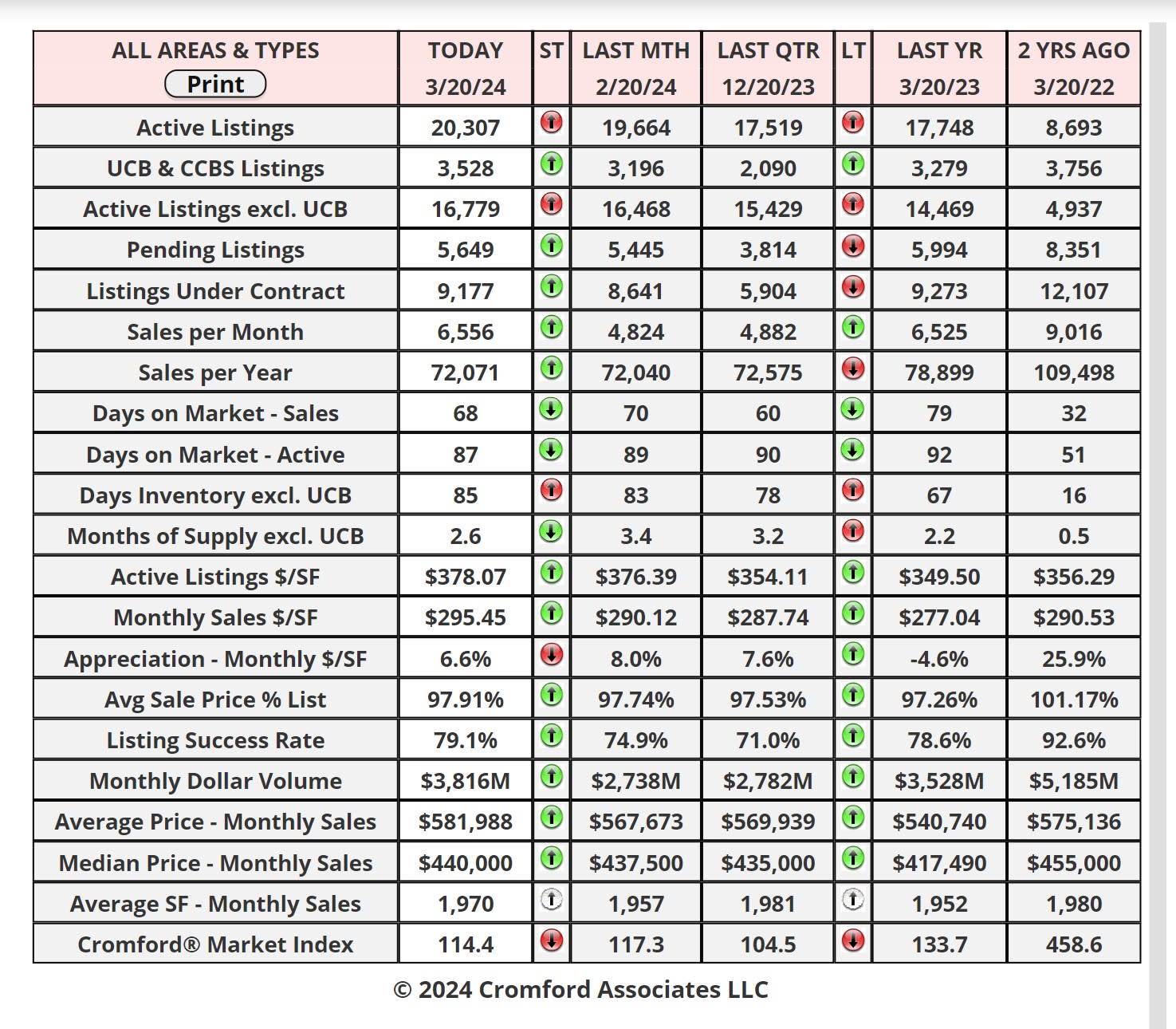
Market Dashboard – Active Listings
All the statistics shown are for the entire Arizona Regional area as defined by ARMLS. All residential resale transactions
recorded by ARMLS are included. Geographically, this includes Maricopa county, a large part of Pinal county and a small
part of Yavapai county. In addition, "out of area" listings recorded on ARMLS are included, although these usually
constitute a very small percentage of total sales and have very little effect on the data.
commercial units, and multiple dwelling units are also excluded.
Daily Market Snapshot – City Ranking
area. The figures shown are for the entire Arizona Regional area as defined by ARMLS. All residential resale transactions
recorded by ARMLS are included. Geographically, this includes Maricopa county, the majority of Pinal county and a small
part of Yavapai county. In addition, "out of area" listings recorded in ARMLS are included, although these constitute a very
small percentage (typically less than 1%) of total sales and have very little effect on the statistics.
Cromford Market Index
cities.
Cromford Market Index Commentary
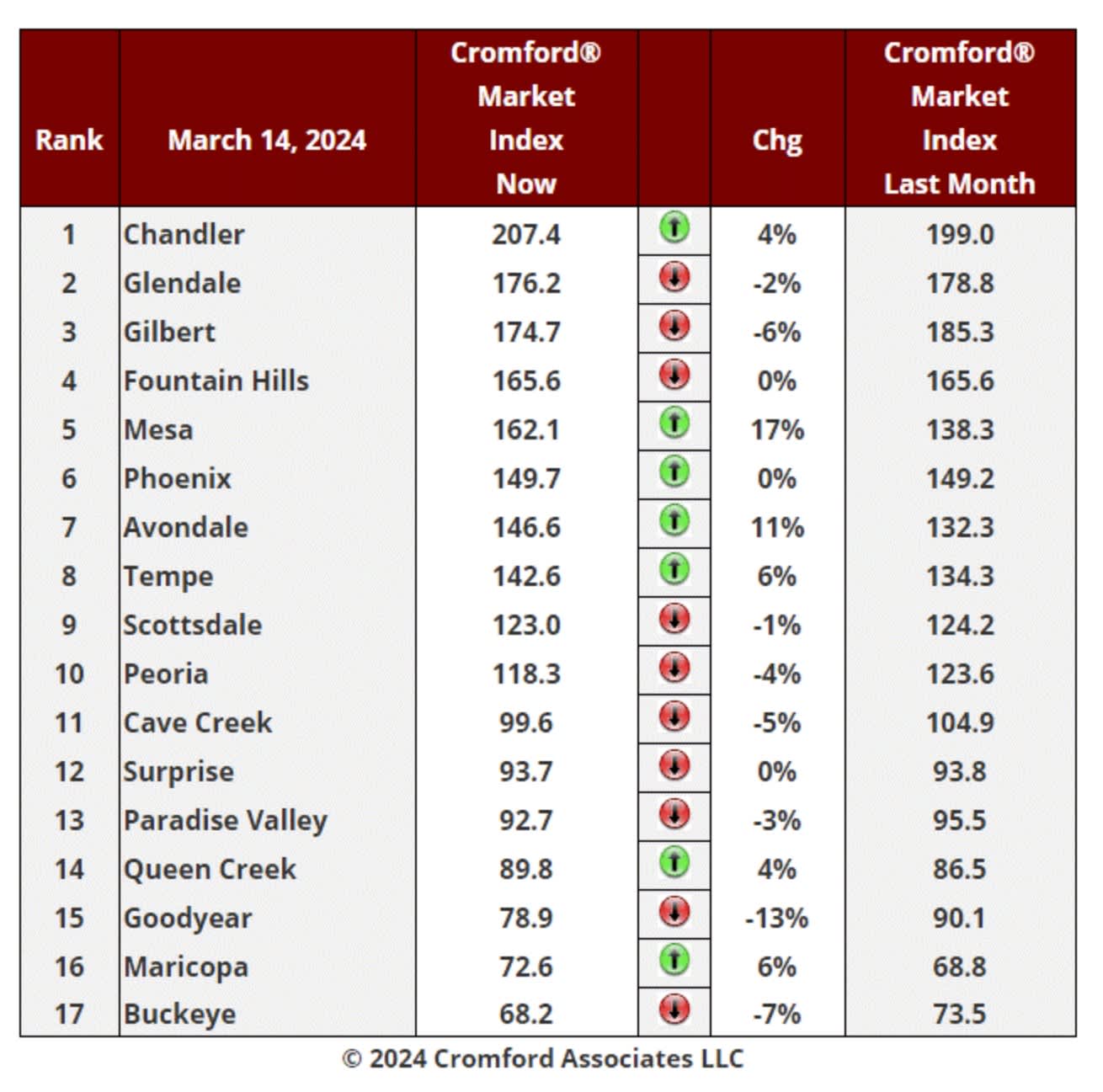
The table deteriorated for sellers since last week, but only slightly. The average change in CMI over the past month
is +0.4%, down from 0.8%. There is a wide gap between the top and the bottom of the table.
We have 7 cities showing an increase in their Cromford® Market Index over the past month, while 10 have declined.
This is another table with a majority of red markers, with Glendale changing sides after a very good run higher. In
fact, despite its CMI moving lower, it jumped into second place over Gilbert, which declined by a larger amount.
Mesa is primarily responsible for the positive average, aided by Avondale. There are no other cities with double
figure percentage increases. Goodyear and Buckeye are once again leading the downward movement, the latter
now well below 70 with Maricopa opening up a gap after improving by 6%.
10 out of 17 cities are still seller's markets. We have 3 cities that are balanced and 4 are buyer's markets. Queen
Creek's stay in the balanced range of 90-110 was short-lived.
Both supply and demand are rising, but both at a very slow pace. Supply has slightly more momentum and so the
overall CMI has fallen back from 117 to 115 over the past month. This slight deterioration for sellers is not what
they hope to experience in the prime buying season. The average 30-year fixed rate mortgage dropped to 6.85%
on March 8, but has climbed back over 7% again. We are not anticipating significant improvement in demand unless
and until we see rates fall lower and stay consistently below 6.5%.
Listing Success Rate
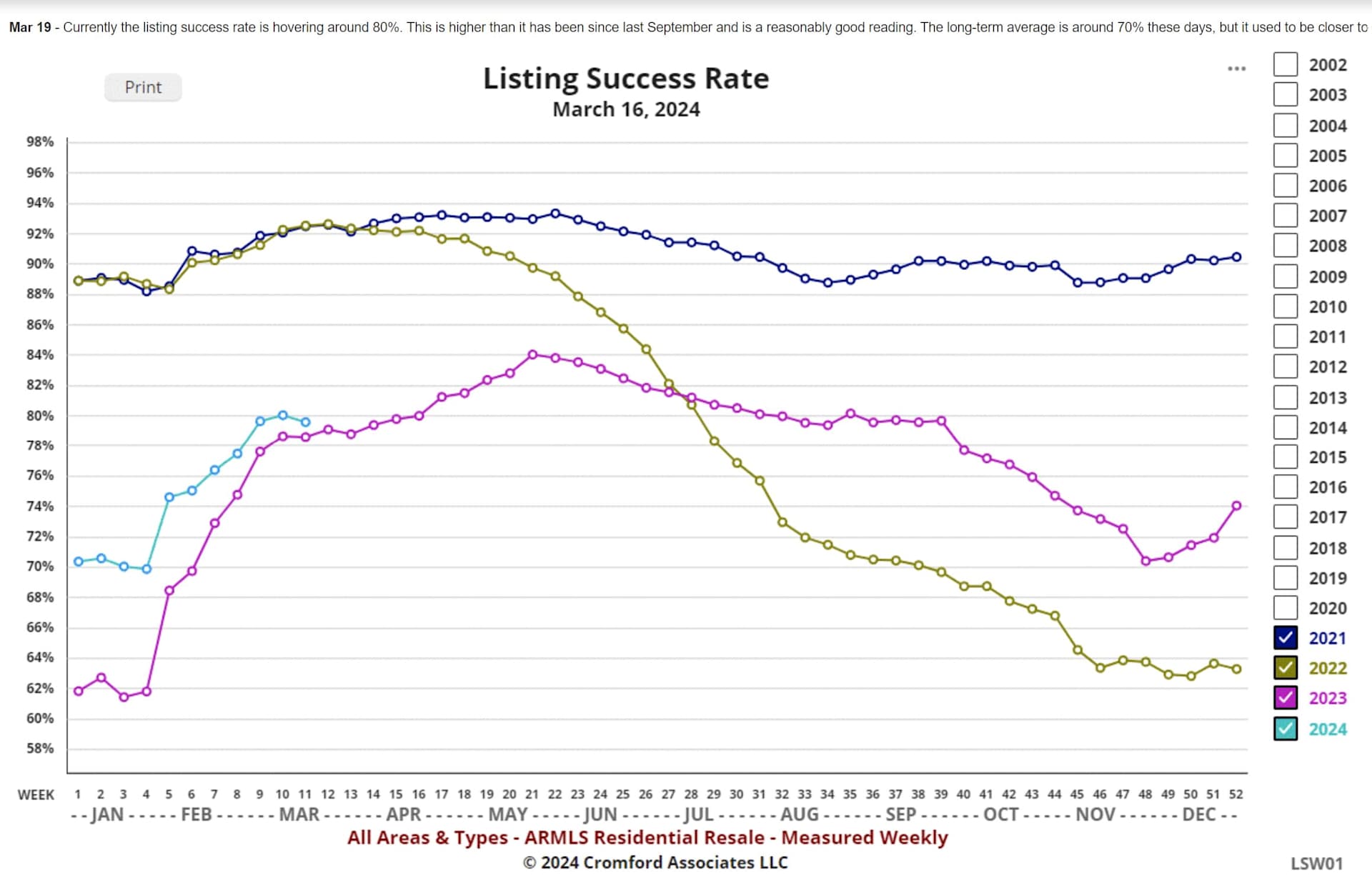
Mar 19 - Currently the listing success rate is hovering around 80%. This is higher than it has been since last
September and is a reasonably good reading. The long-term average is around 70% these days, but it used to be
closer to 65%.
It is a little higher than this time last year and means that 4 out of 5 listings end with a successful close rather than
getting cancelled or expiring.
If you are looking for good news, this is in that category.
How Real Estate Transactions Operate in the UK – Interesting Read
Mar 18 – Ever wonder what real estate transactions are like in England where there are very few buyers who are
represented by agents. This is prompted by the recent legal agreement with NAR. This has yet to come into effect
but is scheduled for the middle of 2024 and will introduce some major changes into the way compensation is
negotiated for buyer's agents. It is possible that more buyers will not be represented at all.
I think most Arizona agents would be surprised by how different the processes are in the UK, so for those who are
interested, here are the first 38 differences identified:
1. Commissions are typically 1% to 1.5% payable by the seller to the “estate agent” who advertises the property.
The better the agent the higher the commission, generally speaking.
2. The buyer is usually unrepresented, but there are a few specialist buying agents, used only by very rich people to
find suitable properties. These buying agents are paid by the buyer. Buyer's agents claim that their negotiation
skills get a lower price for the buyer and this more than pays for their fee.
3. Caveat emptor applies – the seller is under no obligation to reveal defects in the property. However, most are
reasonably honest. Never rely on it for anything important.
4. There are few lawsuits if something goes wrong. The buyer is expected to do all necessary due diligence before
closing and anything discovered afterwards is tough luck.
5. There are no title companies or title insurance.
6. There is no MLS. Properties are advertised on a variety of web sites, dominated by Rightmove and Zoopla, which
cover the whole country.
7. There is no Zillow or anything equivalent.
8. The laws are different in Scotland and Northern Ireland, and I am familiar with the England and Wales system
only.
9. Parties can back out of the agreed sale until exchange of contracts, typically a week before closing. After the
exchange of contracts, the buyer will lose their deposit if they back out. Deposits are usually 10%.
10. Gazumping and gazundering are common in times of fast price changes. These involve the buyer or seller
changing the agreed price before a contract exchange. Google the terms if they are unfamiliar (which is likely).
11. Both buyer and seller use a solicitor to represent them in preparing contracts. Each party has their own solicitor,
they cannot share one. A solicitor is a kind of lawyer, but they aren’t qualified to represent you in courts like an
attorney would be. Sometimes the lender will require a third solicitor to represent them. These can add a lot to
closing costs.
12. The solicitor has a fiduciary duty to their client. Agents do not, as they are just marketing the property for the
seller and often exaggerate or tell outright lies. Estate agents are not held in high esteem in the UK, but solicitors
are usually respected.
13. Estate agents have no required education and are not licensed. Anyone can be an estate agent just by choosing
to call themselves one. However wise sellers will carefully choose an agent based on reputation and local
knowledge.
14. If an agent works for a large agency, they will normally receive a salary plus commission. Very few people work
for commission only.
15. No formal contract is used in making an offer. The offer may be just a phone call followed by an email
confirmation, voicemail or text message.
16. Property titles are recorded in a national database – the Land Registry. It can take months for a purchase to be
recorded. Loans are recorded against the property along with other restrictions or covenants that may place a
heavy burden on the new owner.
17. Sellers can sell a home without an agent (like a FSBO), but this is rare unless they are using a “We Buy Any
Home” company as a buyer.
18. Closing takes 3 to 5 months typically. Many things can and do go wrong and sales often fall through because
something odd is discovered after the sale is agreed.
19. The listing agent is paid out of the proceeds of the sale, as is the solicitor. Each party gets their own closing
statement, not a common one for both.
20. After agreeing a price, the buyer must conduct many searches to check the condition and legal status of the
property. These searches are arranged by the buyer’s solicitor but require the cooperation of the seller’s solicitor.
They can take a very long time, sometimes months.
21. It is common for the seller to show the property, rather than relying on the selling agent attending.
22. It is usual to have a long chain of transactions that all have to close at the same time. One end of the chain is a
buyer who does not need to sell and at the other end is a seller who does not need to buy. All the others have to
buy and sell at the same time. This is a mess, but perfectly normal. You just have to keep calm and carry on.
23. Planning permission is a crucial ingredient. An acre with no planning permission may be worth $10,000. With
planning permission, it could be worth $500,000. Planning permission comes from the local government authority.
24. There are no fixed rate mortgages for more than 5 years. Most mortgages are variable rate, but some are called
fixed rate which means the rate is held steady for a short period up to 5 years.
© 2023 Cromford Associates LLC - Walt Danley Local Luxury | Christie’s International Real Estate
25. Lenders will usually require a formal valuation, and these are often quite expensive and usually paid for up front.
The borrower pays for this.
26. There are no government guarantees on loans, and nothing like FHA, VA, FANNIE MAE or FREDDIE MAC.
27. Down payments are usually larger, typically at least 10% and often 25%.
28. Fishing rights, hunting rights, mining rights etc are often separated from the property in question.
29. There are very few HOAs but most properties have restrictions attached to their title deeds. The buyer will have
to find out what they are and they may be so onerous that they back out.
30. There are almost no condominiums (called common hold in UK). Apartments are almost always leasehold rather
than freehold (fee simple) and a third party owns the land and the freehold on the building. Owners must pay the
freeholder ground rent, though this is often a trivial amount or even zero in a few cases. The leasehold will have a
termination date which may be not far into the future or many centuries away. Important to check.
31. A tax is payable by the buyer based on the contract price. This must be paid in full immediately after completion.
It is called Stamp Duty Land Tax and can amount to a very large sum, especially on luxury properties. It is zero or
small on most entry-level properties. The tax is higher for investors and second-home purchasers. It is also
higher for buyers from abroad.
32. School catchment areas are a very critical factor for buyers with children. Schools are sometimes very inflexible
about who they will accept, based on their home address.
33. Public transport is widely used, so proximity to a train station or bus service is a key issue in valuation.
34. Very few properties have air conditioning.
35. Many properties have no parking of any kind, as they were built before car ownership was widespread.
36. The median home is about 60% of the size of the median home in Arizona. (1200 sq. ft. versus 2000 sq. ft.) but it
will probably be built with more substantial materials (stone, brick, slate) and expected to last a lot longer.
37. Some homes are several centuries old. Mine is at least 200 years old and no-one remembers when it was first
built.
38. No termites, scorpions or rattlesnakes, but mold is a problem because it is very damp a lot of the time.
There are many more - if you ever move to the UK, you will need to unlearn most of what you knew about real
estate. However, you could start work as an agent on day one with no education!